

While territorial contiguity was a fundamental structural flaw that contributed to the eventual separation of Bangladesh, the lack of communication, language barriers, limited interest of Pakistan’s mainstream political parties in Balochistan, as it does not provide them a vote bank, along with the absence of good universities, industries, and cultural and social exchanges, which could attract people of Punjab to Balochistan, has created deep mistrust and a lack of understanding of Balochistan’s crisis in rest of Pakistan.
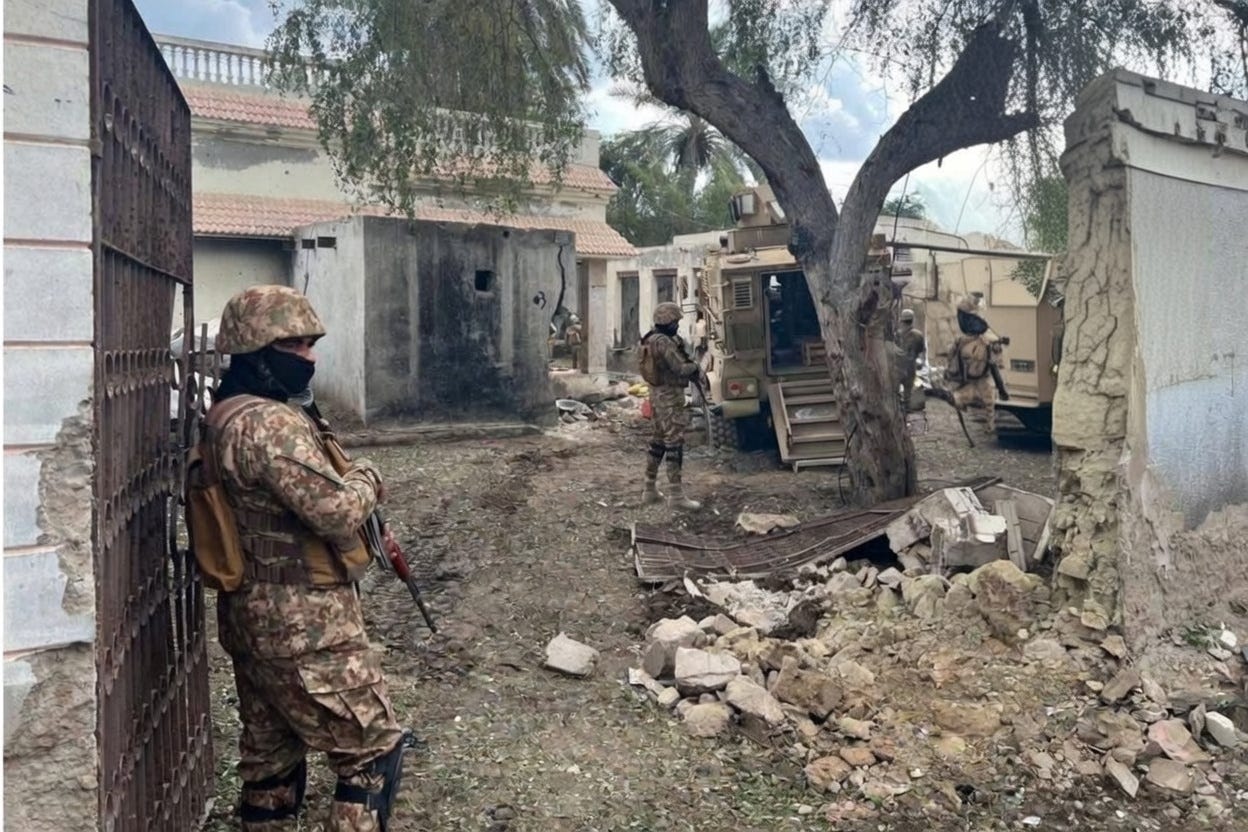
Fighting between the ethnic Baloch armed group, the Baloch Liberation Army (BLA), and Pakistani security forces, which began on Saturday in the country’s south-western province of Balochistan, was still continuing on Monday afternoon, according to multiple reports.
Reports say fierce clashes continued in the eastern districts of Nushki and Washuk until Monday, areas bordering both Afghanistan and Iran. Balochistan violence has taken an alarming turn, with several female suicide bombers, aged between 24 and 60, participating in the fighting. The BLA has released pictures of women bombers as young as 24 and as old as 60. Such involvement of women must raise serious concerns for a state about what is motivating both young and elderly women to join a violent insurgency. This should also concern a state when Baloch insurgents were roaming the cities and towns, people were seen hugging them, kissing their foreheads, and one video circulated showing women praying for them, saying, “Allah help you, Allah protect you, Koran protect you, and may you see a free Balochistan while alive.”
Such scenes should force a state to think about why the local population has started viewing Baloch insurgents as national guardians, while the army and security personnel are increasingly seen as enemies. If the state responds with more force and repression to such scenes, violence will escalate, and more of the public may move to support insurgents. It is time for the state to undergo a fundamental reassessment of its Balochistan policies.
What is Fuelling the Insugency
Overall, the situation in Balochistan has been dramatically deteriorating since 2018. That year’s general elections were regarded by many observers as deeply manipulated, with a new political party, the Balochistan Awami Party (BAP), emerging almost overnight and being brought into power. The party lacked popular legitimacy and public support. Corruption increased significantly, while few practical measures were taken to address widespread poverty. Governance in the province dramatically worsened, and the door to engagement, reconciliation, and dialogue with disgruntled Baloch leaders closed. The state also did not take any economic measures to alleviate poverty, improve the lives of ordinary people, or create better economic opportunities for them, relying instead on security to contain an insurgency that rose its head in 1948.
Young people, already disappointed, frustrated, and resentful towards the state, increasingly saw armed groups as a saviour.
Public anger had already been high over the China-Pakistan Economic Corridor (CPEC), which many locals feel failed not only to deliver economic benefits but also to bring greater militarisation and hardship. In Gwadar, residents who had long depended on fishing and informal cross-border trade with Iran for their livelihoods saw both activities curtailed by security measures linked to CPEC, a $62 billion investment in Pakistan and the flagship project of its Belt and Road Initiative. Promised economic alternatives and the transformation of Gwadar, the CPEC gateway to Dubai or Singapore, did not materialise, further deepening resentment.
As CPEC came to be viewed by many as exploitation, a new development in March 2022 added to local concerns. Canadian-based giant mining firm Barrick Gold Corporation signed a landmark agreement with Pakistan’s federal government and the Balochistan provincial government to revive the massive Reko Diq copper and gold project, ending a long-running legal dispute. Under the deal, Barrick was granted a 50% stake, with the remaining 50% divided between Balochistan and federal entities.
For many in the province, this backed the perception that Balochistan’s natural resources were being extracted without the consent of the local population and without meaningful benefit to ordinary people.
Balochistan’s Artificial Leadership a Stumbling Block Between Islamabad and Local Baloch
For years, a segment of tribal chieftains, corrupt politicians, and elites within Balochistan have been accused of exploiting local suffering and misrepresenting Balochistan’s realities to Islamabad and Punjab.
A major issue between the federal capital, Punjab, where many key decisions are made, and Balochistan has been a persistent communication gap. Critics argue that the military, bureaucracy, and political leadership in Punjab have little understanding of Balochistan’s social and political dynamics, and Balochistan’s artificial leadership is further deepening this divide.
Mainstream political parties have a minimal presence in the province, largely because they lack electoral capital there. Balochistan has a small population with only 16 seats in the National Assembly of Pakistan, which does not attract mainstream political parties. As a result, they invest little effort in understanding local concerns. On the other hand, Punjabi bureaucrats often have limited exposure to Balochistan, while ordinary Pakistanis in Punjab rarely encounter it through education, employment, or economic activity, as the province has no major industries that could offer jobs to Punjabis or good institutions and universities where students from Punjab could come to study. In Punjab and Islamabad, knowledge of Balochistan is limited to brief mentions in school textbooks that it is a mineral-rich province of Pakistan, or to their knowledge coming from the imposed artificial leadership of Balochistan, who use their wealth, contacts, and power to keep misleading people through the media.
This lack of understanding has shaped public perceptions in Islamabad and Punjab. With the rise in violence, much of Pakistan’s population now associates Balochistan primarily with insurgency, often accepting narratives that blame foreign involvement, particularly India. Even senior politicians have frequently echoed such claims.
Analysts argue that while a small group within Balochistan has long misled federal authorities, Islamabad itself failed to engage directly with locals and instead relied on local intermediaries. While territorial contiguity was a fundamental structural flaw that contributed to the eventual separation of Bangladesh, the lack of communication, language barriers, limited interest of Pakistan’s mainstream political parties in Balochistan, as it does not provide them a vote bank, along with the absence of good universities, industries, and cultural and social exchanges, which could attract people of Punjab to Balochistan, has created deep mistrust and a profound lack of understanding of Balochistan in Punjab and Islamabad. The result is a massive security crisis that has now escalated to unprecedented levels.
In recent clashes, reports have emerged of the state using drones in Nushki to target militants. Some local sources have alleged that drones may also have been used in civilian areas, though such claims remain contested.
Following Saturday’s violence, many analysts say it is time for Islamabad and Punjab’s leadership to recognise the true nature of the conflict and the depth of long-standing grievances in Balochistan, including issues of political marginalisation, unequal representation, and a deep sense of isolation among the Baloch population.
Responding to violence with further force has repeatedly failed. Over the past two decades, the state has largely relied on military solutions, yet the insurgency has grown more lethal and organised rather than weakened.
What is Next?
It is high time the state considers dialogue, reconciliation, and a comprehensive reassessment of Pakistan’s Balochistan policy.
As part of immediate confidence-building measures, Islamabad must immediately dismiss the current provincial government, form a national government, release civil rights activist Dr Mahrang Baloch and other members of the Baloch Yakjehti Committee (BYC), suspend existing policies related to Balochistan, call an all-party conference on Balochistan in Quetta, and hold genuinely free and fair elections as early as possible.
As fighting continues across parts of the province, the crisis in Balochistan appears to be entering a critical phase, one that may determine whether Pakistan pursues a political resolution or remains locked in a cycle of escalating conflict.