

On Saturday morning, in an unprecedented wave of violence, the Baloch Liberation Army (BLA), which seeks an independent Balochistan, said it had launched coordinated attacks across twelve towns in the province.
Among the hardest hit was Quetta, the provincial capital, where armed men carrying automatic weapons were seen in several parts of the city. Militants attacked police positions, torched a bank, and set police vehicles on fire. Similar scenes were reported in Nushki, Mastung, Kalat, Kharan, and other towns, with footage circulating widely on social media.
Security forces said 67 militants had been killed as operations continued following what they described as foiled coordinated attacks at multiple locations. The BLA, however, claimed its fighters struck 48 different sites across 14 cities, killing 84 members of the security forces. These figures could not be independently verified.
Where has violence been reported?
Local officials and government sources have so far reported unrest, clashes, and bombings in Quetta, Noshki, Mastung, Dalbandin, Kalat, Kharan, Panjgur, Gwadar, Pasni, Turbat, Tump, Buleda, Mangochar, Lasbela, Kech, and Awaran.
The full scale of the attacks remains unclear. However, suicide bombings and vehicle-borne improvised explosive devices (VBIEDs) were reported in Quetta, Pasni, Gwadar, Noshki, and Dalbandin.
Casualty figures are still emerging, with strict information controls and internet shutdowns imposed across several cities as this report is being filed.
The BLA has described the latest violence as “Operation Herof, Phase 2.0”.
What is “Herof”?
Herof is a Balochi literary term meaning “black storm”, commonly used in Baloch poetry, including by the veteran poet Karim Dashti.
The BLA first launched Herof Phase One in August 2024, carrying out attacks across 12 districts in Balochistan.
During that phase, a female suicide bomber targeted a security forces camp in Lasbela district, about 125 kilometres from Karachi. Militants also killed 22 people in Musakhel, near the Punjab border, after forcing passengers out of vehicles and checking their identities.
Both Lasbela and Musakhel had traditionally been regarded as relatively peaceful areas.
What makes Herof II different from Phase I?
The current wave of attacks is broader in scope, more intense and more violent, with operations spread across a wider geographic area and involving a larger number of fighters.
For the first time, women are reported to be taking part in direct combat alongside male militants. Previously, female involvement had been limited to suicide attacks.
Several videos circulating online appear to show women participating in clashes with security forces.
An officer from Pakistan’s Intelligence Bureau in Quetta estimated that between 800 and 1,000 fighters, including a small number of women, may be involved in the coordinated attacks. The BLA has not confirmed those figures.
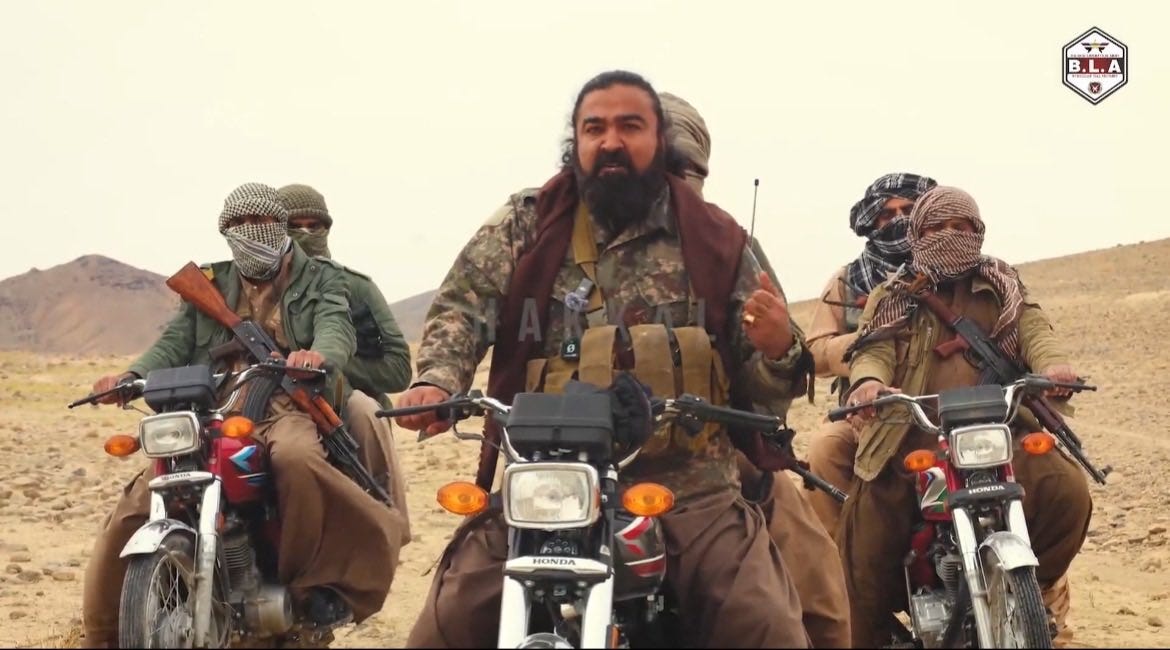
Another striking feature of this phase has been its media strategy. The BLA released footage showing its leader, Bashir Zaib, a former student who became a guerrilla commander, sitting on the back of a Japanese-made Honda 125 motorcycle.
His previous video appearance had been released by the group’s media wing, Hakkal, in June 2024.
In the latest footage, Zaib is seen with a beard and long hair, wearing a jacket and gloves, clothing that suggests the video was recorded recently, in line with current weather conditions.
Observers note that the image of Zaib riding a motorcycle may be a deliberate symbolic tactic. A similar image of Syria’s President, Ahmed al-Sharaa, also known as Abu Mohammed al-Jolani, went viral when he was seen sitting on the back of a motorbike before assuming power, a moment widely interpreted as a symbol of mobility, accessibility, and control of territory. The BLA video appears to mirror that symbolism.
Where was Zaib filmed, and why was this location chosen?
According to a Baloch traveller familiar with the region, the mountainous terrain, landscape, and a single cemented road seen in the video suggest it was filmed between Kharan and Chagai.
A senior Baloch journalist described the choice of location as strategic.
Dalbandin, in the wider Chagai region, is home to vast mineral resources, including the major Reko Diq and Saindak projects. There has been growing international interest in Reko Diq, with mining giant Barrick Gold pledging to invest around $7 billion in developing gold and copper deposits in two phases.
The Asian Development Bank is also expected to provide a $410 million financing package for the project, while the United States, Japan, and several European countries have shown interest in investment.
Analysts say Bashir Zaib’s appearance in this area sends a clear message to both the Pakistani government and foreign investors, underlining the BLA’s ability to operate in regions central to Pakistan’s economic ambitions.
Many Baloch have long opposed large-scale foreign investment in the province’s mineral sector, saying that local communities have not benefited.
Zaib’s presence in Balochistan also appears to counter the perception that he is based in Afghanistan, a point that may ease pressure on the Afghan Taliban from international actors.
Why has the BLA become stronger?
Analysts link the insurgency’s growing strength to political developments and security policies in Balochistan since 2018.
That year’s elections were widely criticised as heavily manipulated, leading to the installation of a government seen by many locals as disconnected from public needs and deeply involved in corruption.
Opportunities for political dialogue and engagement narrowed, while the province became increasingly militarised.
The Counter Terrorism Department (CTD) was granted expanded powers and has been accused by rights groups of enforced disappearances, extrajudicial killings, and dumping of bodies.
A major turning point came in August 2020, when a university student, Hayat Baloch, was shot dead by paramilitary Frontier Corps personnel in Kech district in front of his parents. The incident occurred a day before Pakistan’s Independence Day and sparked widespread outrage.
Later, a large Pakistani flag was erected in the area, which many locals saw as further inflaming tensions.
Public anger was already high following the killing of a young woman, Malik Naz, who was shot inside her home in May 2020 in what was described as an armed robbery by allegedly security forces-backed criminals.
The handling of Haq Do Tehreek protests, a civil rights movement originating in Gwadar, also deepened resentment in 2023. Following clashes between protesters and authorities, internet services were suspended for ten days in January 2023.
In November 2023, CTD killed a young man, Baalach Mula Baksh, in custody, labelling him a militant, a claim disputed by his family, triggering protests across the province.
Further demonstrations led by activist Dr Mahrang Baloch in Islamabad from December 2023 into early 2024 were met with crackdowns.
The February 2024 elections were again widely criticised as manipulated. The new government has been accused by critics of denying the existence of a Baloch problem, relying on media messaging rather than addressing long-standing grievances.
Protests surrounding the Baloch Raaji Muchi national gathering in July 2024, and a sit-in in Gwadar led by Dr Mahrang Baloch, ended with security forces opening fire, killing several people.
Dr Mahrang Baloch was detained in March 2025 under public order laws and now faces dozens of cases, with new charges reportedly filed as she secures bail in earlier cases.
Analysts say a series of developments between 2018 and 2025 helped turn what had been a low-level insurgency into a far more organised and deadly conflict. Despite this, critics argue that the Pakistani authorities continue to underestimate the scale of the insurgency. In August 2024, the country’s interior minister, Mohsin Naqvi, drew attention for remarks suggesting that Baloch armed groups could be easily dealt with by a Station House Officer (SHO), which were widely seen as downplaying the seriousness of the situation.
Analysts say Mahrang Baloch’s imprisonment has sharply increased anger and frustration among youth who believe peaceful struggle is no longer an option. Her arrest has contributed to rising recruitment into armed groups, including among women, as seen in the latest clashes.
Why did the BLA choose this moment for Herof II?
Observers believe the timing of the operation was carefully calculated.
With major protests and instability drawing global attention in neighbouring Iran, militants in Balochistan may be seeking to highlight that a violent resistance is also unfolding next door in Pakistan.
As peaceful protests in Balochistan have increasingly been criminalised, with demonstrators frequently detained under public order laws, the BLA appears to be projecting strength through armed action.
Given Balochistan’s long border with Iran, analysts say the proximity of large-scale violence to a region already under international focus is likely intended to attract attention from global audiences, including in the Middle East, the United States, and far beyond.