

While the 21-hour engagement between the U.S. and Iranian delegates was framed domestically as a diplomatic victory, two incidents in Balochistan, one on land and the other at sea, passed with relatively little national focus.
The first was the targeted killing of four members of the Shia Hazara minority in Quetta.
Local media reported four people from the Shia minority were shot dead on the city’s outskirts. The attack was claimed by the Islamic State’s Pakistan affiliate, a group that has consistently targeted Shias and regards Iran as a principal adversary.
The timing was hard to miss. An attack on a Shia minority, claimed by a group hostile to Iran, during the presence of a high-level Iranian delegation in Pakistan carries a significant political message. Yet it struggled to command sustained attention in the national conversation.
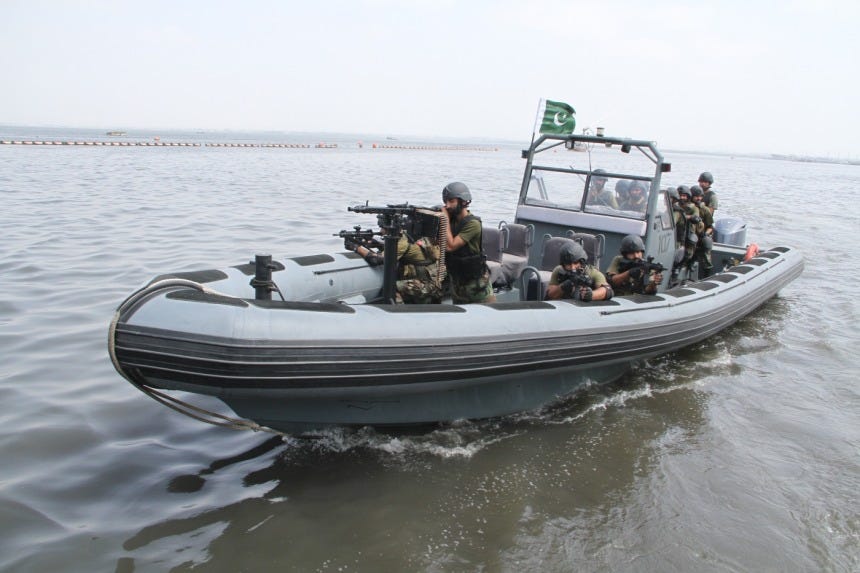
The second incident unfolded off Pakistan’s southwestern coast and may prove more consequential.
A Pakistan Coast Guard patrol boat was attacked near Jiwani, not far from the Strait of Hormuz, one of the world’s most sensitive maritime chokepoints. Local officials confirmed that three personnel were killed.
The Baloch Liberation Army (BLA), which is banned in Pakistan and listed as a foreign terrorist organization by the United States, said it was behind the assault. In its statement, the group described the attack as the start of activity in maritime zones, framing it as an effort to disrupt what it calls the exploitation of Baloch resources.
That claim, if borne out in future attacks, would mark a dramatic shift in BLA’s activities.
For years, the BLA’s campaign has been largely land-based, focused on infrastructure, security forces, and symbols of the state within Balochistan. Extending that fight into coastal waters suggests a broader ambition and a willingness to target spaces tied to international trade.
A Wider Context
These developments come as regional tensions ripple through global shipping.
With instability around the Strait of Hormuz prompting caution among commercial operators, alternative routes and ports along the Arabian Sea have taken on added importance. Karachi has seen uneven but notable shifts in activity as vessels adjust to the changing risk environment.
For economies dependent on energy flows and maritime trade, from Europe to East Asia, even limited disruption in this region can carry consequences well beyond its immediate geography.
Against that backdrop, an attack on a coast guard vessel, however small in scale, is not easily dismissed. It touches directly on perceptions of safety in waters that are becoming more, not less, strategically relevant.
Pakistan, for its part, has been keen to position Gwadar and its wider coastal infrastructure as future gateways for regional commerce. That ambition depends as much on stability as it does on investment.
The timing adds another layer. The incidents coincided with foreign delegations in Islamabad discussing the future of the Strait of Hormuz, as well as the role Pakistan could play alongside Saudi Arabia in securing maritime routes near the Strait. The incident comes at a time when Karachi Port is seeing a noticeable rise in activity, with more vessels docking as shipping lines steer clear of the increasingly risky Strait of Hormuz. By late March 2026, transshipment volumes had climbed sharply, with the port handling more than 8,860 TEUs in less than a month, surpassing the total recorded for the entire previous year.
In that context, even a limited attack in Pakistani waters is likely to unsettle shipping operators, raising concerns over safety, insurance premiums, and the reliability of these emerging routes.
Reading the Signals
Taken together, the two incidents point in different directions, but both raise familiar concerns.
In Quetta, the Hazara killings are a reminder that sectarian violence, though less frequent than in the past, remains a live threat, one that can further explode if Pakistan stands with Saudi Arabia to protect its defense pact.
Off Jiwani, the message is less about sectarianism and more about strategy. If the BLA sustains operations at sea, it would open a new front, one that links a local insurgency to global trade routes.
For Pakistan, the consequences are greater.
On one hand, it is seeking relevance as a diplomatic interlocutor in a volatile region and aiming to provide maritime security to the Strait of Hormuz, as reported in Pakistan. On the other hand, ongoing and, in some cases, evolving security challenges at home risk complicating that narrative.
The gap between those two realities is not new. But moments like this fuel anxiety, further heightening uncertainty about safety and insurance costs for international sailors.